
It is eleven o’clock. The working day ended hours ago. You have eaten, you have sat down, you may have poured a drink. By any reasonable measure, you are off the clock. And yet the mind has not received that message.
Tomorrow’s agenda is running in the background. The conversation from this afternoon is being replayed, re-edited, re-resolved. A decision you made at three o’clock is being second-guessed by your own brain at a time when there is nothing useful you can do about it. You are tired enough to want to stop. You are simply not able to.
This is not a discipline problem. It is not anxiety in the clinical sense – though it can become that, given enough time. It is a specific neurological state that affects almost every high-performing professional who carries significant responsibility, and it has a mechanism. Once you understand the mechanism, the question stops being why can’t I switch off and becomes what does switching off actually require.
What Is Actually Happening in Your Nervous System
The human nervous system has two primary operating modes. The sympathetic branch governs the alert, active, decision-ready state – what most people know loosely as fight-or-flight. The parasympathetic branch governs recovery, rest, and repair. Under normal conditions these two modes cycle naturally. Pressure rises, the sympathetic system activates; pressure passes, the parasympathetic system restores balance.
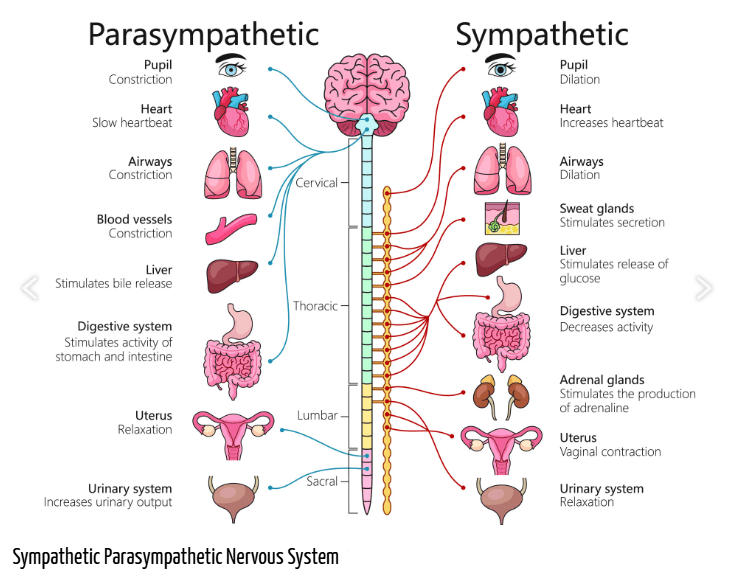
For the professional carrying sustained, high-stakes cognitive load, this cycle is disrupted. The sympathetic nervous system – activated reliably every working day by the weight of decisions, performance pressure, and the accumulated demands of leadership – begins to recalibrate. Elevated becomes normal. The persistent activation of the stress response is no longer a reaction to a specific threat. It is the new baseline.
When this happens, the end of the working day does not constitute sufficient signal for the nervous system to shift modes. Cortisol – the primary stress hormone, responsible in part for keeping the brain alert and processing – remains elevated. The prefrontal cortex continues its work. The mind, taking its instructions from a physiological state rather than from the calendar, does not stop because you have decided it should.
You are not failing to relax. Your nervous system is operating exactly as it has been conditioned to operate. The problem is that it has been conditioned to a state that no longer serves you.
Why Evening Routines Do Not Solve It
The standard advice for unwinding after work – exercise, a clear separation between work devices and personal space, a consistent evening routine, limiting screen time – is not wrong. For someone whose nervous system is in a manageable state of moderate activation, these interventions work. They provide sufficient signal to allow the body to begin the downward shift toward rest.
For the professional in a state of chronic sympathetic overdrive, they are insufficient. Not because the advice is poor, but because the system it is trying to shift is operating at a level that evening routines do not reach.
Consider what an evening routine is asking of your nervous system. It is asking a body flooded with stress hormones, a brain accustomed to continuous high-stakes processing, and an autonomic nervous system that has recalibrated its baseline upward – to respond to a change of lighting and the absence of a laptop. The signal is too quiet for the noise it is competing with.
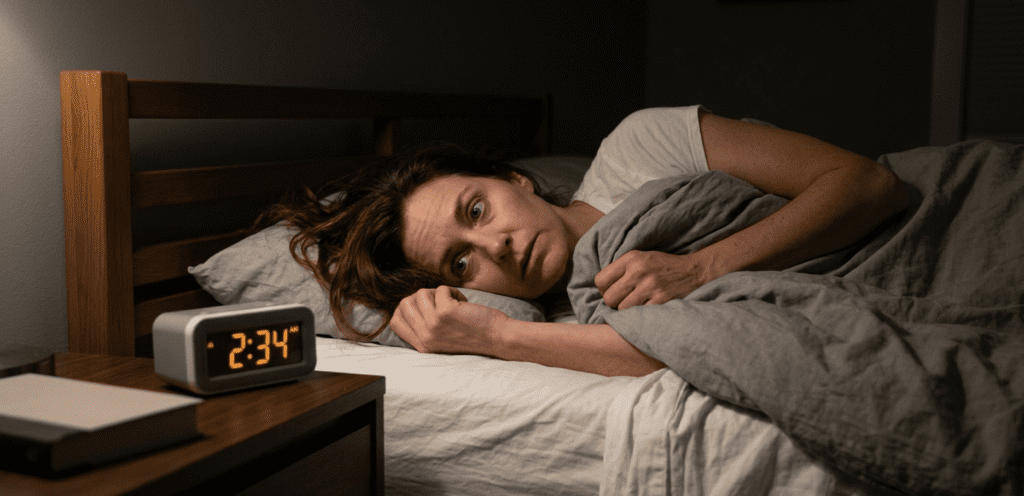
This is why you can do everything correctly in the evening – the bath, the book, the absence of screens – and still lie in the dark at midnight, alert, processing, unable to reach the rest you have technically given yourself every opportunity to reach.
The Role of the Prefrontal Cortex
Understanding why the mind loops after hours requires understanding what the prefrontal cortex – the region responsible for planning, judgement, decision-making, and self-regulation – is doing under sustained executive load.
The prefrontal cortex does not operate like a muscle that simply tires and stops. When depleted, it does not go quiet. It becomes less effective at filtering and prioritising while continuing to process. The result is the specific quality of late-night thinking that high performers will recognise immediately: not productive thought, not useful planning, but an undiscriminating loop that recycles the day’s inputs without resolution.
There is also a self-regulation component. One of the prefrontal cortex’s functions is the regulation of attention itself – the ability to direct focus deliberately and to disengage from an unproductive line of thought. When this region is depleted, that capacity diminishes. The loop is not just running; the mechanism that would normally interrupt it is also compromised.
This is why telling yourself to stop thinking about work – a cognitive act, performed by the very region that is depleted – does not work. You are asking an exhausted instrument to perform the task of its own recovery.
What the Research Actually Points To
The literature on genuine parasympathetic recovery – the kind that produces measurable neurological restoration rather than temporary suppression of symptoms – converges on a consistent finding. The nervous system does not downregulate in response to instruction or intention. It downregulates in response to experience.
Specifically: experiences that remove the requirement for active decision-making, that place the individual in an environment where the cognitive burden of control is genuinely absent rather than merely reduced, produce a qualitatively different physiological response than conventional rest.
Polyvagal theory, developed by Dr Stephen Porges, describes the neurological conditions under which the parasympathetic nervous system is able to fully assert itself. They are not conditions of passive inactivity. They are conditions of felt safety – a specific physiological state, not a cognitive assessment – in which the nervous system receives, at a level below conscious interpretation, the signal that sustained alertness is no longer required.
For most high performers, this state is not produced by evenings at home, however well-managed. It requires a more deliberate intervention – one that engages the nervous system at the level where the problem actually lives.
The Specific Relief of Relinquishing Control
There is a particular quality of exhaustion that belongs specifically to people who are always in charge. The accumulation of being the one with the answers, the one who holds the outcomes, the one whose composure the room takes its cues from. This is not simply cognitive load. It is the sustained weight of a performed identity – the version of yourself that cannot afford to not know, cannot afford to be uncertain, cannot afford to show the depletion that is, in fact, present beneath the surface. This is the Architecture of Control I discuss in other posts.
This identity does not clock off at the end of the working day. It travels home. It sits at the dinner table. It lies awake beside you. And it is one of the primary reasons the mind cannot stop – because the role has not been set down, only the office.
What becomes possible when that role is genuinely, structurally set aside – not reduced, not managed, but removed entirely within a contained environment governed by an external authority – is something that no amount of personal discipline produces. The nervous system, released from the requirement to maintain the performance of control, shifts. Often within minutes.
The loop stops not because you have instructed it to, but because the physiological conditions that were sustaining it have changed.
This is the mechanism at the centre of the work at The Inner Vice. Not a technique for managing the problem. A structured environment that removes the conditions producing it.

If the Evening Is the Worst Part of Your Day
For many of the professionals who come to The Inner Vice, the question why can’t I switch off has been present for longer than they care to calculate. It is not a bad week. It is a state – one that has gradually become so familiar it no longer reads as abnormal, only as the price of operating at the level they operate at.
It is not the price. It is a symptom of a nervous system that has not been given the conditions it needs to genuinely reset. And it is one that responds, often dramatically, to an intervention that addresses it at the correct level.
Sessions are available across Surrey and Central London. Enquiries are selective. If you recognise what is described here, introduce yourself.