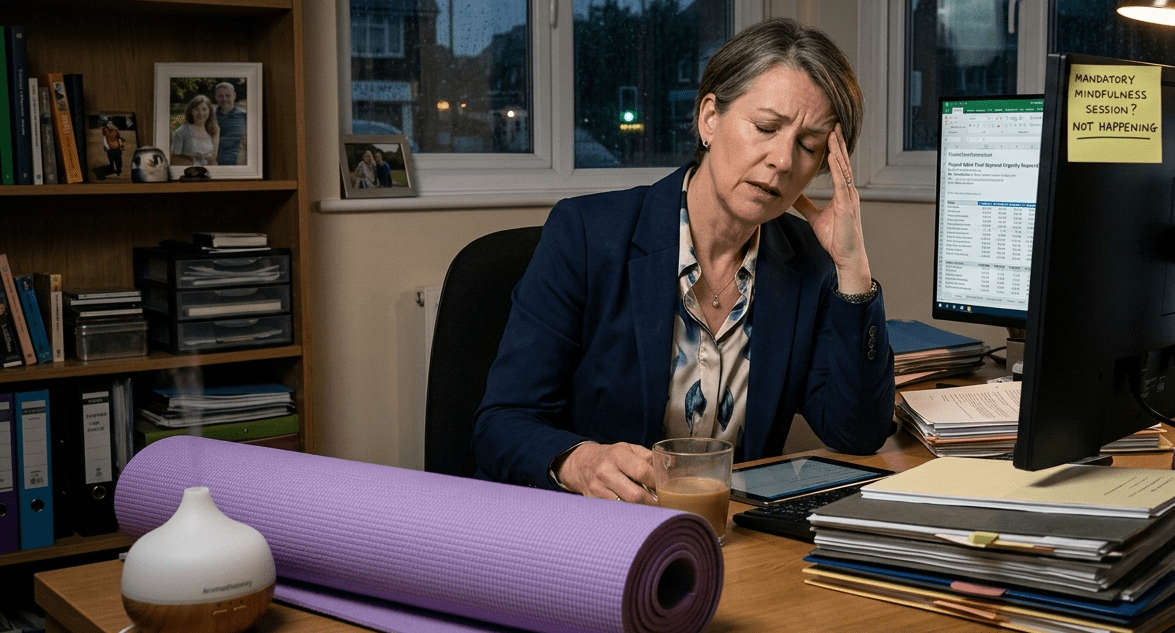
The long weekend that was supposed to clear your head. The holiday you could not stop checking your phone on. The meditation app you used for three weeks until the discipline of it became another thing to maintain. The early nights that left you lying in the dark, processing the same loop of responsibilities with no useful outcome.
Each of these is, in principle, good advice. For most people, in most circumstances, it works. You are not most people in most circumstances. And the reason none of it has worked for you is not a failure of discipline or commitment. It is a mismatch between the tool and what is actually happening in your nervous system.
You Are Not Failing to Relax. Your Nervous System Is Refusing To.

Standard relaxation advice is built on a simple assumption: that stress is the presence of pressure, and that removing pressure produces rest. For moderate stress in most people, this holds. Remove the meeting, take the afternoon off, lie in the garden – and the body follows. The parasympathetic nervous system, responsible for rest and recovery, reasserts itself. The stress response winds down.
For the high performer operating under sustained, high-stakes cognitive load, this mechanism has been systematically overridden. The nervous system – specifically the sympathetic branch, responsible for fight-or-flight – has been running in a state of chronic activation for months or years. It has, in effect, recalibrated. The elevated state has become the baseline.
When this happens, removing the external pressure does not remove the internal state. The body does not know the meeting has been cancelled. It does not know you are on holiday. Cortisol remains elevated. The mind continues processing. The off switch has not broken – it has been overridden so consistently that the signal is no longer recognised.
This is not a mindset problem. It is a physiological one. And it cannot be resolved by doing less.
Read our in-depth article about Executive Burnout Recovery
Why Each Standard Approach Falls Short
Holidays
A change of location removes you from the environment but not from the state. If the nervous system is in chronic sympathetic overdrive, it travels with you. The first two days of any break are typically spent decompressing to the point where genuine rest might become possible – and then it is time to return. You come back from holiday unchanged, sometimes more depleted than when you left, because the gap between what you expected and what you experienced adds its own weight.
Sleep
Sleep is the body’s primary recovery mechanism, but it requires the nervous system to downregulate sufficiently to reach the deeper stages where genuine restoration occurs. When the stress response is chronically active, sleep becomes shallow. The hours happen but the recovery does not. You wake carrying the previous day’s load.
Mindfulness
Mindfulness-based interventions work by directing conscious attention to the present moment – quieting the narrative mind, interrupting the loop of forward-planning and retrospective processing. For moderate stress, this is effective. For the professional in chronic sympathetic overdrive, it asks the prefrontal cortex – the cognitive region already depleted from months of high-stakes decision-making – to perform more cognitive work. It is asking the exhausted part of the brain to solve the problem of exhaustion. For some people it provides temporary relief. For most high performers, it does not hold.
Exercise
Physical exercise reduces cortisol acutely and, done consistently, builds resilience to stress over time. It is genuinely useful and worth maintaining. What it cannot do, at any intensity, is produce the specific quality of cognitive reset that the overloaded executive nervous system needs. It addresses the body. The depletion is in the prefrontal cortex and the autonomic nervous system. These do not respond to physical exertion in the way that muscular fatigue does.
Executive coaching and therapy
Both valuable. Neither addresses the physiological state directly. Coaching works at the level of strategy, behaviour, and performance. Therapy works at the level of insight, narrative, and emotional processing. Both are cognitive interventions that ask the depleted mind to do more thinking. For someone whose primary problem is a nervous system that cannot downregulate, thinking harder about it – however skillfully guided – does not reach the level where the problem lives.
What the Nervous System Actually Needs
The research on genuine parasympathetic recovery – the kind that produces measurable restoration rather than temporary symptom suppression – points consistently to the same requirement: an experience that bypasses cognitive interpretation entirely.
The nervous system does not respond to reasoned argument. It does not downregulate because you have decided it should. It responds to environment, to embodied experience, to the removal of the conditions that keep it elevated. Specifically: when the requirement to be in charge – the source of most of the sustained cognitive load in a senior professional’s life – is removed entirely, and an external authority assumes that governance, something measurable happens.
The prefrontal cortex, no longer required to perform, rests. Heart rate decreases. Cortisol drops. The parasympathetic nervous system, freed from continuous override, asserts itself. The result is not relaxation in any conventional sense – it is a system reset. A genuine return to baseline that no amount of passive rest has managed to produce.
This is the mechanism behind the work at The Inner Vice. Not a wellness intervention. Not a cognitive technique. A precisely structured environment in which the professional’s requirement to decide, manage, and perform is suspended – and the nervous system is finally given the conditions it needs to actually stop.
If You Have Tried Everything Else
The professionals who come to The Inner Vice have usually arrived at the same conclusion by different routes: the standard approaches have been tried, some have helped at the margins, none has produced the quality of reset that the underlying state actually requires.
What they have not yet tried is an intervention that addresses the problem at the level where it lives – in the body and the nervous system, not the mind.
Sessions are available across Surrey and Central London. Enquiries are selective. If you are ready to try something that works through a different mechanism entirely, introduce yourself.